
Got excited about running a marathon in 1972. After watching Nina Kuscsik, the first official woman finisher in Boston Marathon history. Wasn’t long, I was looking at the 1972 Marathon Handbook, thinking maybe I could be like Bill Scobey, maybe lead a big race. This was before I learned I was slow. – JDW

When did you start running and why?
Mad Dog – no relation – Bill Scobey: In the Fall of 1960, I was a Sophomore at Cleveland HS, Reseda, California. Cleveland was part of about one hundred high schools in the Los Angeles City Unified School district. Most of these schools did not have a Freshman class. Ninth graders were all still in Junior High School. President John F. Kennedy started his program, dubbed “The President’s Council On Physical Fitness” in 1960.
Starting with a series of about ten tests, which consisted of softball throw for distance, high jump, long jump, speed on the horizontal bars, chin-ups, 100-yard dash, etc. One of the tests was to see how fast we ran a half-mile on the track. I was told the reason behind it was to compare American school kids fitness against other countries – mainly Russia.
When I ran the half mile I ran faster than most of the kids on the track team and was asked why I didn’t go out for Cross County. I said, I saw that sport on a card we all filled out and decided I would never be able to run from Los Angeles to New York without killing myself. Ha-Ha.

Come Spring of 1961, the coaches all ganged up on me and convinced me to run on the track team. I had no idea how I would do and I was so far back in the line to get my uniform they had run out. Coach told me not to worry. Just get a pair of red shorts and you can change your singlet with someone who had already run.
First meet, I ran the “B” 1320 at Belmont HS in downtown L.A. – and I won! I couldn’t hardly believe it. Needless to say, I was issued my very own Kit for the rest of the season. I went all the way to the L.A. City Meet without losing a race. After the summer I went out for Cross County and was number two man on the Varsity Squad. Cleveland won the West Valley League and we were on our way to the City Championship. Unfortunately, I got sick and couldn’t show up on the starting line. Broke my heart.
In 1962, I won all my mile races (no Two-Mile in those days), and ended up Third Place in the City Mile, earning a spot at the State Meet in Modesto, CA. First time on a airplane. Great time, except someone swiped my spikes and I had to run in a quarter miler’s shoes that were two sizes too big. Obviously, I did horribly, ending up in the middle of the pack at the finish line. Only time they ran the State Meet Final Mile race in two heats and picked the places of the two heats on result times. Never did it before or after 1962.

My folks drove up to Modesto in my Dad’s Corvette and sat next to Gregory Peck and his wife who were there to watch their son Jon Peck run in the 880-yard final. Two of Gregory Peck’s best movies were filmed that year (To Kill a Mockingbird & Cape Fear).
My senior year of cross county I won the L.A. City School Championship. There was no California Cross Country State Meet before 1987.
Toughest opponent and why?
I had a list of tough opponents, but actually I was my own worse enemy (opponent) getting myself all worked up mentally over my up-coming races instead of relying on my fitness and speed – the two things I became known for, my mileage and my speedwork. In HS my own teammate Norm Bain was tough until I finally beat him in the mile. And I never looked back. He moved to the 880 after that. At Pierce JC the guy that beat me in the City HS Championships, John Kennedy came from Verdugo Hills HS and wanted to train under Atis “Pete” Petersons and Bob Chambers (former USC and two-time 800 meter Olympic qualifier in 1948 and ’52.
I was an All-American several times at Pierce JC in several events and our distance team set a National Record in the 4 X Mile in 1965.
After my last season at Pierce, I got drafted into the US Army in early 1966. My first year in the Army I never ran, but January 1967 I was recruited while serving in South Korea as a tank driver. The team was training at Ft. Sam Houston in San Antono, TX and spent the next two years running for my Country while working on getting back into racing shape. HaHa…

All along I was in close contact with Coach Jim Hunt at Humboldt State College and his push got me into school the first quarter of 1969. I won the NCAA DII 3 mile at Ashland College, OH. My teammate Gary Tuttle won the Steeplechase that same day and Vince Engel was All-American in the Mile. I ended up 4 X All-American in track and cross country, and made the Olympic Committee’s Running Camp at Washington State University where we set the World Record in the National T&F News postal 10 man/24 hour Relay.
On December 5th, 1971 while I was in graduate school at HSC, I ran my fastest time for the marathon at the Western Hemisphere marathon in Culver City, CA. I ran 2:15:21, which happened to be the fastest marathon run that year in the entire Western Hemisphere. I believe I ended up the 6th fastest marathoner in the World that year.
February of 1972, I left Humboldt after receiving my California Teaching Credential and, while searching for a teaching/coaching job, I worked in the construction industry. Several of my junior college running teammates had already been working as firefighters or policeman in Ventura County and was convinced to do the same. Something my Grandfather use to tell me; “If you want to make something of yourself, you should look into becoming a fireman. You get plenty of time off to train and in the end you end up with a great retirement ,while gaining the respect of your peers.” It made since to me then and still does some fifty-five years later.
Most memorable run and why?
My most memorable run was a postal race that I ran with teammate Vince Engel in the spring of 1971. It was sponsored by Track & Field Newsletter. The two-man/10-mile relay. The two runners would exchange the batton every lap for 20 laps each. Vince and average around 62 seconds a lap. We set some kind of record and I actually saw the result in one of those newsletter T&F put out about twice a month, but I can’t for the life of me where I saw it posted.
Biggest disappointment and why?
My two biggest disappointments were not trying to make it to the Olympics, and not running under 4 minutes in the mile.

What would you do differently if you could do it again? Why?
When I graduated from Humboldt State and got my teaching credential, I needed to get my shit together, get a job (no money in running in those days) and take care of my family. But. as I said. I should have taken off for Oregon and trained with the Eugene group in order to run sub-four-minute mile and make the 1972 Olympic marathon team. As they say; “Hindsight is 20/20.”
Favorite philosopher? Quote?
Ha-Ha. My favorite quote from my favorite philosopher came from Frank Shorter when he was asked; “Why do you run marathons?”
…”cuz I’m good at it!”
Special song of the era?
I have several. To pick one is hard. I would have to say Gordon Lightfoot’s 1972 “Beautiful.” I have a wide range, however. Frank Sinatra & Nelson Riddle’s “Summer Wind” from 1965. The Rolling Stone’s from 1971 “Wild Horses”. Anything from Earth, Wind & Fire, The Isley Brothers, The Stylistics and Curtis Mayfield.
Favorite comedian?
Favorite comedian by far was George Carlin with a distant second was Sam Kinison.

What was your ‘best stretch of running’? (I have three stretches).
1.) My high school days from the Spring of 1961 to the end of 1962. 2.) My All-American Junior College days from 1963 to Spring of 1965 3.) My tenure at Humboldt State College the Spring of 1969 through Spring of 1972. I basically quit running track when I left Humboldt the end of the Spring Quarter of 1971.
I still ran lot’s of miles at various speeds, but a lot of miles until 2010.
And so why do you think you hit that level at that time?
I was very focused and determine during those three stretches.
What was your edge?
I personally pushed myself to run twice a day and cover between 100 and 120 miles a week. I quit running in 2010 after suffering a heart attack. I had 100% blockage in my right coronary artery. Overnight hospital visit, angioplasty and the insertion of three stents basketed together. I’ve been in great health since.
What supplementary exercises did you do?
Before and after any run I would stretch, push-ups, sit-ups, chin-up and sets of twenty-pound dumbbells working on the upper body – quick reps.
What was your toughest injury and how did you deal with it?
I really had no major injuries before I quit competitive track. In 1975 I had a couple of bouts with plantar fasciitis of my left foot. I suffered for two years until I had the Kerlan-Jobe Orthopaedic Clinic fix it in 1978.
Bill retired from the Oxnard Fire Department in 2001 after thirty years of service. Apparently, he had a side hustle. 1976, Bill opened The Athletes Foot in Port Hueneme, the first specialty running store in Ventura County.

How Mad Dog Got His Name by Jerry Jobski, OGOR.
Summer of 1970. Olympic Development Camp at Washington State. I believe it was three weeks and I believe it was in August. A great place to situate a camp and a great time of year to concentrate on running. There was nothing else to do except run. There was one movie theater in town and the movie only changed once a week. Way before cell phones and streaming services.
Bill and I were both at the camp and both of us liked to train “high volume” workouts. Lots of distance running usually twice a day.
I digress. On to the answer to your question. Bill at that time was running for the Mad River Runners, a collection of misfits associated with Humboldt State. As the training camp progressed that August long ago, I notice Bill going out for another run around noon…. THREE runs a day in Pullman, Washington. I decided he was Mad. He became the Mad Dog from Mad River. All of the runners around the camp latched onto the Mad Dog moniker and it stuck.
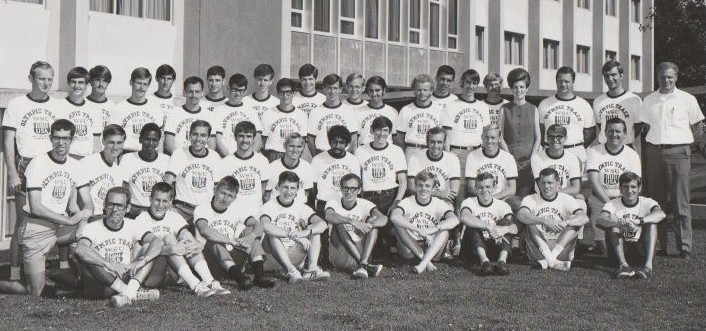
Jobski is in the second row, third from the right. Mark Covert crouches next to him on his right and Bill Scobey is standing directly behind Mark.
When the running camp at WSU was in its last week, someone came up with the idea of running a 24-hour relay. You know, that bit of madness where you have a ten-man team and you take turns running a mile. This goes on for 24 hours. Bill Scobey cemented his claim to the Mad Dog title as he averaged close to 4:30 for his 30-31 miles.
Submitted as remembered, hopefully accurate.
Scobey splits: Fastest Mile: 4:22.0 (The event’s absolute fastest leg). Overall Average: 4:26.3 per mile.

The Mad Dog is nothing if not – to paraphrase Elaine Benes – podcast-worthy. Here’s another.
One more, what the hell…. https://running70s.com/tag/marathoner